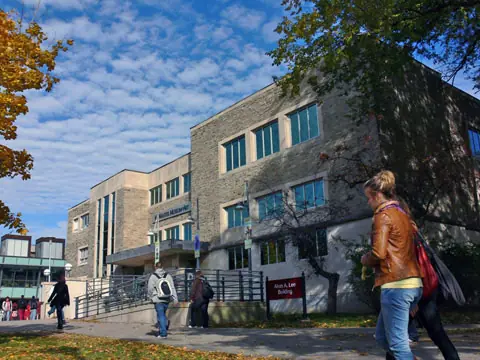

History and building
McMaster University was founded in 1887, and its art collection began with portraits of presidents and faculty. A donation of European prints by the Carnegie Institute in the 1930s led to more systematic collecting and programming. By the 1950s, regular art exhibitions were presented on campus in Mills Memorial Library. In 1967, with the help of History Department chair Togo Salmon, the McMaster Art Gallery was given a purpose-built facility in the east wing of Togo Salmon Hall. The gallery moved across campus to its present larger location where it opened to the public under a new name, the McMaster Museum of Art, on June 11, 1994. Five years later the building was renamed the Alvin A. Lee Building in honour of President Emeritus Alvin A. Lee, an influential champion of the museum whose efforts helped make the current building possible.
The museum is attached to Mills Memorial Library at the corner of Sterling Street and University Avenue. The museum's current location in the Alvin A. Lee Building opened in 1994. The move from Togo Salmon Hall provided a larger location for the museum. The museum describes itself as a meeting space for both the campus and the community situated within the traditional territories of the Mississauga and Haudenosaunee nations and within the lands protected by the Dish With One Spoon wampum agreement.
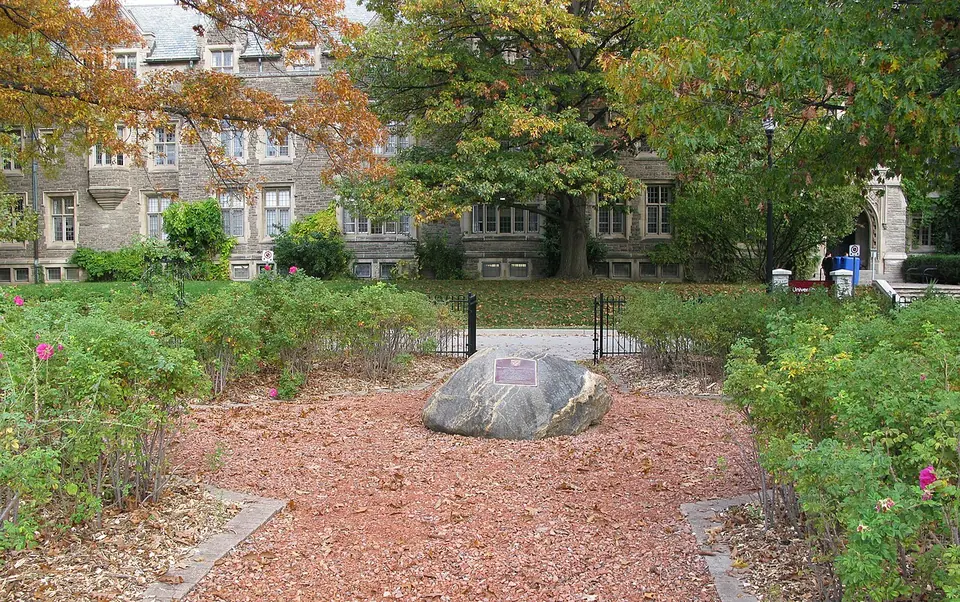

The collection
The permanent collection consists of over 7,000 objects and is considered one of the finest university collections in Canada. Its growth was guided by faculty members and the Wentworth House Art Committee, established to acquire contemporary Canadian and European art. Professors Karl Denner and George Wallace are credited with the advancement of the German Expressionist art collection in the early 1960s. A major development came in the 1980s with the donation of over 200 European works by Hamilton jeweller Herman Levy. He later bequeathed $15.25 million to the museum with specific directions that the money must be spent within five years on acquisition of art of non-North American origins. More recently, the Donald Murray Shepherd Trust provided funds for the purchase of contemporary European art from notable artists such as David Bomberg, Christian Rohlfs, and Natalia Goncharova.
The collection spans from the late 15th to the 21st century. The Herman H. Levy collection includes significant Impressionist and Post-Impressionist paintings by artists such as Gustave Courbet, Claude Monet, Camille Pissarro, Vincent van Gogh, and Gustave Caillebotte. There is a strong holding of early 20th-century German prints by artists including Ernst Barlach, Max Beckmann, Otto Dix, Ernst Ludwig Kirchner, and Käthe Kollwitz. European Old Master paintings and prints from the 16th century include works by Sir Thomas Lawrence, Willem Claeszoon Heda, Gerrit Dou and Michiel Sweerts.
The museum also collects 20th-century European modernist and contemporary art from Ben Nicholson and Marcel Duchamp to Joseph Beuys, Anselm Kiefer, Anish Kapoor, Antony Gormley and Gerhard Richter. Its Canadian art is a survey collection with historical works by Tom Thomson, A.Y. Jackson and other members of the Group of Seven, alongside contemporary works by established mid-career and senior artists including Barbara Astman, Betty Goodwin, Shelagh Keeley, Arnaud Maggs, and Tony Scherman. Other areas include Inuit art with an emphasis on Cape Dorset prints and sculpture, and antiquities. The museum's Paper Centre contains over 4,000 prints, drawings, and watercolours viewable by appointment. It is also home to the Bruce Brace Coin Collection, consisting of coins and medallions from ancient Rome and Greece from as early as the fifth century BC.
 Play video: The Contemporaries: This Must Be The Place - Artist Talk at McMaster Museum of Art
Exhibitions and programs
The museum offers year-round exhibits consisting of historical, modern and contemporary art. It hosts the McMaster University BFA graduating exhibition and a variety of public events including lunch and learn sessions, artist talks and workshops. The Education Gallery serves as a multipurpose room for lectures and study and houses the museum's modest library made up of books, artist's files and exhibition catalogues. The museum provides guided tours and hands-on educational activities customized to group interests. It also offers self-guided group tours, and individuals or groups of fewer than 10 can visit during open hours without an appointment. The museum works with faculties across the university on collaborative projects and exhibitions that use university research and experts.
In 2024, the exhibition "The Clichettes: Lips, Wigs, and Politics" won the Exhibition of the Year award at the 48th annual Galeries Ontario/Ontario Galleries awards. The exhibition was a retrospective of the performance trio The Clichettes, active from 1978, and featured 150 costumes, props, videos, photographs, and scripts. The museum belongs to the Ontario Association of Art Galleries reciprocal program, through which members of participating galleries receive free admission. The museum's fourth-floor Board Room, with a capacity of 16, is available for bookings and is free for university groups, while a fee applies for off-campus groups.
- The museum hosts Sketching Thursdays and 'Night at the Museum' events as part of its public programming.
- It offers The Art of Seeing Program as part of its educational offerings for groups and classes.
- Research appointments can be made to view works in the Paper Centre, which contains drawings and watercolours.
- The museum engages in public art commissions and acquires recent works, with a submissions process for artists.
- It provides a social narrative guide to help visitors understand what to expect during a visit, including accessibility features.
- The museum states its aim is to positively disrupt the traditional museological narrative by creating more inclusive, dynamic and experiential relationships between peoples and artistic practices.
Admission and visiting details
The museum is located in the Alvin A. Lee Building at 1280 Main Street West on the McMaster University campus. All galleries are wheelchair accessible. The museum provides a visual and written social narrative guide to help visitors prepare for their visit. The primary visitor parking lots for the university are lots G, H, I, Q, and M, which offer paid parking nearby.
| Day | Hours |
|---|---|
| Tuesday | Open |
| Wednesday | Open |
| Thursday | Open |
| Friday | Open |
| Saturday | Closed |
| Sunday | Closed |
| Monday | Closed |
The museum is closed on all statutory holidays. Groups of ten or more visitors are required to contact the education staff in advance to arrange a guided tour. Smaller groups and individual visitors are welcome to explore the galleries without an appointment during regular open hours. All galleries are wheelchair accessible for the convenience of all visitors.
Getting there and transit
The museum is easily reached by public transport, with Hamilton Street Railway (HSR) buses stopping at the door. The nearest GO Transit rail station is the Hamilton GO Centre, located approximately 4.1 kilometres away in downtown Hamilton. This station is a commuter rail station and bus terminal designed in the Streamline Moderne style, originally opening in 1933 as the head office of the Toronto, Hamilton and Buffalo Railway. It was renovated and reopened as the Hamilton GO Centre on April 30, 1996. The station is served by GO's Lakeshore West line trains during peak hours and offers connecting bus service to Aldershot Station at other times.
Many HSR routes stop immediately adjacent to the Hamilton GO Centre on Hunter, James, and John streets, providing connections to the university area. The HSR realigned downtown bus routes in 2009 to use new bus platforms inside the GO Centre as terminus points for routes 1 King, 2 Barton and 3 Cannon. For those driving, the museum is situated at the centre of the McMaster University campus at the corner of Sterling Street and University Avenue. The museum's entrance faces west and is attached to Mills Memorial Library.
The campus and neighbourhood
The McMaster Museum of Art is attached to Mills Memorial Library and is close to the McMaster University Student Centre. The campus is in the Westdale neighbourhood of Hamilton, a residential area centred on the Westdale Village shopping district. Westdale was conceived as a designed neighbourhood in 1911 by architect Robert Pope, an early Canadian implementation of the Garden City Movement. The neighbourhood is bordered to the north by the Cootes Paradise nature reserve, an extensive wetland marking the western end of Lake Ontario. To the south of the campus is the Ainslie Wood neighbourhood, historically an area of farms owned by families such as the Binkleys and Ainslies.
The land south of Cootes Paradise was historically inhabited by successive Indigenous nations. In the early seventeenth century, European explorers encountered the Neutral Nation in this region. Later, the Haudenosaunee Confederacy and then Anishinaabe people inhabited the area. The Between the Lakes Treaty No. 3 in 1792 between the Mississaugas of the Credit First Nation and the Crown allowed for subsequent colonial settlement. This history is acknowledged by McMaster University, which recognizes its location on traditional territories.
- David Braley Athletic Centre, a sports facility, is 310 metres away.
- Ron Joyce Stadium, an arena or stadium, is 400 metres away.
- Saigon Asian Restaurant is 950 metres away.
- Royal Botanical Gardens, a park or outdoor area, is 2.6 kilometres away.
- The Burnt Tongue, a restaurant, is 2.7 kilometres away.
- Dundurn Castle, a museum or gallery, is 2.9 kilometres away.
Nearby
- 1David Braley Athletic CentreSports facility310 m
- 2Ron Joyce StadiumArena or stadium400 m
- 3Saigon Asian RestaurantRestaurant950 m
- 4Royal Botanical GardensPark or outdoor area2.6 km
- 5The Burnt TongueRestaurant2.7 km
- 6Dundurn CastleMuseum or gallery2.9 km
Straight-line distances computed from OpenStreetMap coordinates.
Questions
What are the McMaster Museum of Art hours?
The McMaster Museum of Art is open to the public from Tuesday to Friday. The museum is closed on Saturdays, Sundays, and Mondays. It is also closed on statutory holidays and for extended periods during exhibition changes and university holidays, such as the annual winter break. Visitors should verify the current schedule on the museum's website, as special Saturday openings may occasionally be offered during university events.
How much is admission to the McMaster Museum of Art?
The museum suggests a donation of $5.00, but visitors can pay what they can afford. Admission is free for members of galleries that participate in the Ontario Association of Art Galleries reciprocal program. The museum has described this model as having a suggested fee of $2 in some past materials and tourism guides. There is no mandatory entrance fee, making the museum accessible to the public and the university community. Group tours and educational programs are also offered.
What is in the McMaster Museum of Art collection?
The McMaster Museum of Art's permanent collection consists of over 7,000 objects. It includes significant Impressionist and Post-Impressionist paintings from the Herman H. Levy collection, featuring works by Claude Monet, Vincent van Gogh, and Camille Pissarro. The collection holds early 20th-century German prints by artists like Ernst Ludwig Kirchner and Käthe Kollwitz, and European Old Master paintings from the 16th century. It also encompasses 20th-century European modernist art, a survey of Canadian art including the Group of Seven, Inuit art, antiquities, and the Bruce Brace Coin Collection of ancient Greek and Roman coins. The Paper Centre houses over 4,000 works on paper.
Is the McMaster Museum of Art wheelchair accessible?
All galleries at the McMaster Museum of Art are wheelchair accessible. The museum states it wants all visitors to feel welcome and prepared, and it provides a social narrative guide with visual and written information about museum spaces and accessibility features. The museum is located in the Alvin A. Lee Building on the McMaster University campus, which is attached to Mills Memorial Library. The entrance faces west at the corner of Sterling Street and University Avenue. The museum's website invites feedback on web accessibility issues via email. Paid parking is available nearby in university visitor lots.
Can you take a guided tour of the McMaster Museum of Art?
The McMaster Museum of Art offers guided tours as well as hands-on educational activities customized to group interests. These tours are available for groups and classes by arrangement. The museum also welcomes individuals and groups of fewer than 10 people for self-guided visits during open gallery hours without an appointment. Groups of 10 or more are asked to contact the education staff in advance. The museum provides self-guided options for the outdoor Campus Sculpture Tour and the Campus Architecture Tour as well. The museum's Education Gallery also serves as a lecture and study space.
Sources
- McMaster Museum of Art, Wikipedia.
- Home, McMaster Museum of Art, McMaster University.
- Male nude suits and dresses adorned with sea wildlife: McMaster Museum of Art honoured for exhibition of the y, The Hamilton Spectator.
- McMaster Museum of Art, Tourism Hamilton, Tourism Hamilton.
- Doors Open, McMaster University, McMaster University.
- McMaster Museum of Art: Things to Do Nearby, questoapp.com.