
History and Location
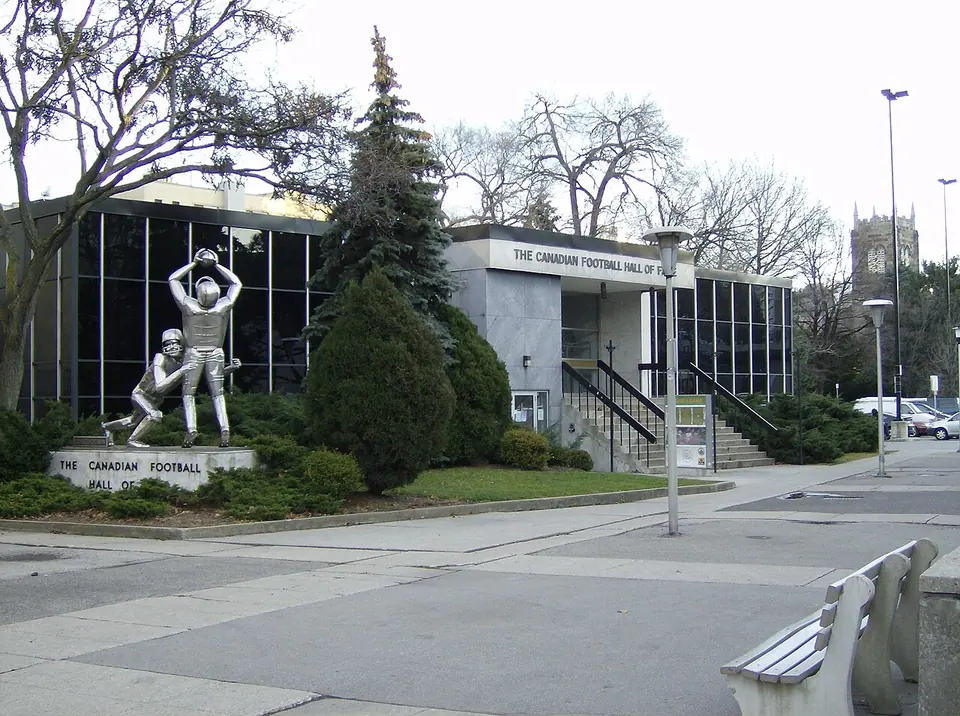
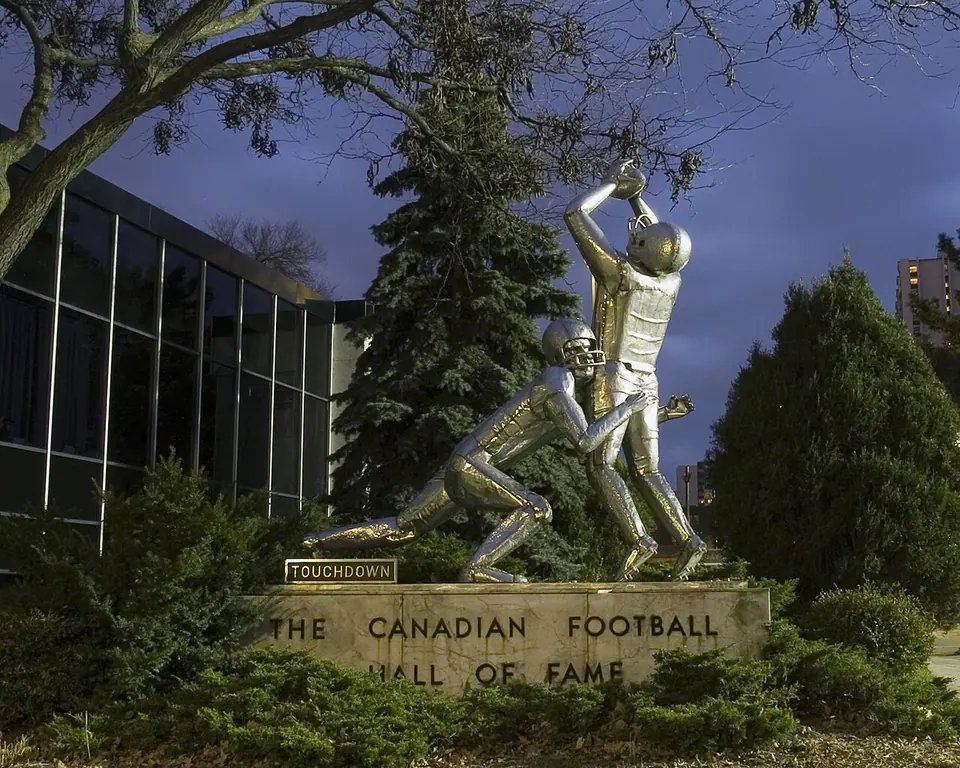
The Canadian Football Hall of Fame was awarded to the City of Hamilton in February 1963 after a successful presentation by Mayor Lloyd D. Jackson. The Hamilton Parks Board initially provided a large, old residence near Civic Stadium as a temporary home. Ivan Miller, retired sports editor of The Hamilton Spectator, was named the first curator. After a few months, the land and building were sold to the Board of Education, and the collection was stored while a new site was sought. Over seven years, several locations were considered, and other cities placed bids to host the national shrine. In 1968, a prime location next to Hamilton City Hall became available, and final negotiations began. The new glass and marble building opened during Grey Cup week festivities in November 1972, the same year Hamilton hosted the championship game. The building was designed by Munro Ploen & Associates of Hamilton. The original building was identified by a slightly-larger-than-life metal sculpture called Touchdown, depicting a receiver being tackled. That sculpture was later moved to Gate 3 of Tim Hortons Field. The Hall closed its original downtown building on September 19, 2015, and responsibility for the museum moved from the City of Hamilton to the CFL that same year. It reopened in 2016 at its current address within Tim Hortons Field, home of the Hamilton Tiger-Cats. The move initiated a decentralized model which does not include a main museum building.

The Collection and Exhibits
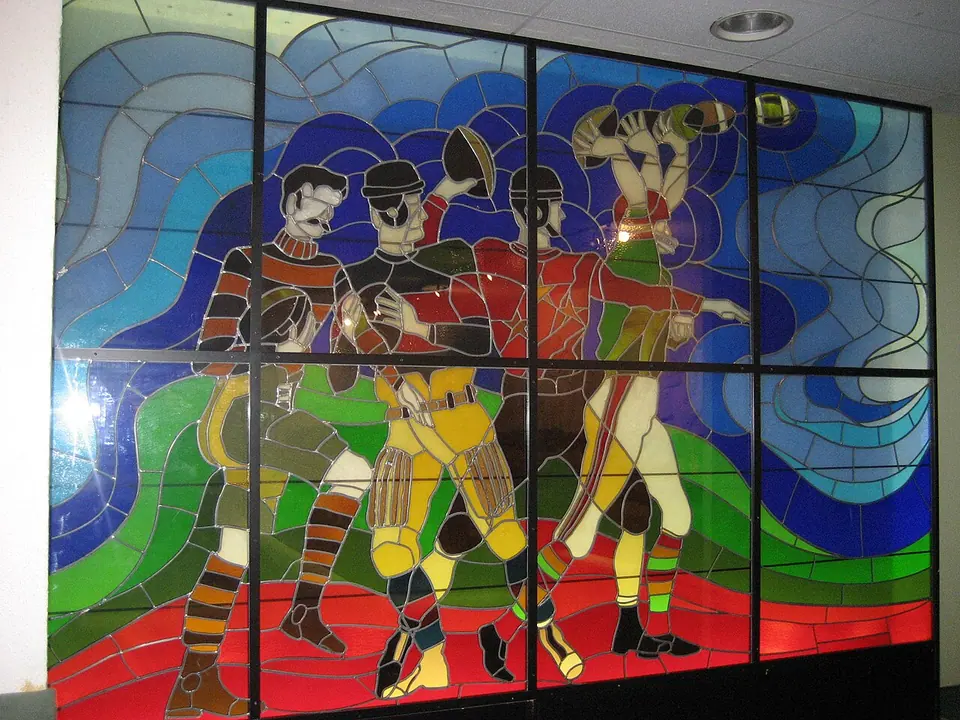
The museum's artifact collections were started in the early 1960s and have increased to over 30,000 items. These consist of trophies, helmets, playing equipment, game and record balls, jerseys, sweaters, jackets, flags, banners, photographs, films, and videos. The collections form a major part of on-site and off-site exhibitions and are used extensively in education programs. A special section of exhibitry called the Zone of Champions is dedicated to the Hall of Famers, displaying the bust and a brief biography of each honoured member. As of March 2018, there were 296 busts in the collection. Tim Hortons Field now houses three primary display areas for the Hall. The Grey Cup display is located at Gate 3, the Media Hall of Fame Wing is in the press box area, and the main display area is on the premium level concourse. The main area features all the busts and rotating displays of various artifacts. These displays are accessible during Hamilton Tiger-Cats home games, with the club-level display open to all ticket holders 15 minutes after the game ends. The museum also coordinates an increasing number of off-site or travelling exhibits annually to promote the Hall across Canada. Past exhibits have included the History of the Grey Cup and the Evolution of Football Equipment.
- The Zone of Champions with over 296 bronze busts of inductees as of 2018.
- A collection exceeding 30,000 artifacts including equipment, uniforms, and media.
- Three dedicated display areas within Tim Hortons Field: Gate 3, the press box, and the premium concourse.
- Travelling exhibits that tour CFL team home fields and other events nationwide.
- Interactive exhibits that have included a field goal kicking feature.
- Displays explaining unique Canadian football rules like the rouge and three-down system.
- Historical artifacts related to the Grey Cup trophy, which was originally intended for amateur senior hockey.
 Play video: The Canadian Football Hall of Fame welcomes its Class of 2026
Inductions and Education Programs
Each year a Selection Committee of football individuals from across the country elects up to seven individuals for induction. Consideration is given in two categories: Builders, for any person who made an outstanding contribution to football in Canada other than as a player, and Players, for any person who played a minimum of five years of amateur or professional football in Canada and achieved outstanding success. A player must be retired from the game for at least three years before being eligible. The Hall of Fame voting committee is composed of sports writers, selected CFL executives, and inducted members. Once during every CFL season, the Hall sponsors an induction ceremony as part of a Hall of Fame Weekend, which includes a regular season game often affiliated with the Hamilton Tiger-Cats. The weekend traditionally includes a celebrity golf tournament, the unveiling of the busts, presentations of Hall of Fame jackets and rings, a gala dinner, and recognition during the Hall of Fame Game. The 2026 induction ceremony is scheduled for September 17, 2026, at the museum. The institution operates two education programs for students in grades K-8: History of the Grey Cup and Suit Him Up: The Evolution of Football Equipment. Outreach Education programs are available to schools in the Greater Toronto Area, the Hamilton Area, and the Golden Horseshoe. The museum also awards the Glenn ‘Keeper’ McWhinney Scholarship to student-athletes, as it did to Hayden Carriere in November 2025 and to Danielle Domingo and Cole Budgen in November 2024.

Visiting Details and Access
The Canadian Football Hall of Fame & Museum is located on the fourth level of Hamilton Stadium, referred to as the Hall of Fame Level, at 64 Melrose Avenue North. The entrance for visitors is through Gate 3, situated in the middle of the west stands off Melrose Avenue. For general public visits, the opening hours as listed on OpenStreetMap are Tuesday through Saturday from 9:30 a.m. to 4:30 p.m. The museum operates as a non-profit registered charity. The institution's website states that to visit, one should go to the Hamilton Stadium 4th level.
| Day | Hours as listed on OpenStreetMap |
|---|---|
| Monday | Not listed |
| Tuesday | 9:30 a.m. to 4:30 p.m. |
| Wednesday | 9:30 a.m. to 4:30 p.m. |
| Thursday | 9:30 a.m. to 4:30 p.m. |
| Friday | 9:30 a.m. to 4:30 p.m. |
| Saturday | 9:30 a.m. to 4:30 p.m. |
| Sunday | Not listed |
Getting There by Transit
The nearest GO Transit rail station is Hamilton GO Centre, located 3.1 kilometres from the museum. This station is a commuter rail and bus terminal in downtown Hamilton, serving as the terminal stop for evening rush-hour Lakeshore West line trains. Off-peak bus service connects to Aldershot Station in Burlington. The station is also a hub for GO bus routes 16, 18, 40, and 47. Local transit is provided by the Hamilton Street Railway. On June 28, 2009, downtown HSR routes were realigned, and new bus platforms inside the GO Centre became the downtown terminus for routes 1 King, 2 Barton, and 3 Cannon. Many other HSR routes stop on adjacent streets like Hunter, James, and John. The Hamilton GO Centre building itself is a Streamline Moderne structure designed by architects Fellheimer & Wagner, which opened in 1933 as the head office of the Toronto, Hamilton and Buffalo Railway.

The Neighbourhood and Nearby Places
The area is dominated by sports and recreation facilities centred around Tim Hortons Field. Hamilton Stadium, an arena or stadium, is immediately adjacent at a distance of 100 metres. The Serafini Family Ice Pad is 240 metres away, and the Bernie Morelli Recreation Centre is 280 metres from the museum. The Jimmy Thompson Memorial Pool is 340 metres away. Gage Park, a large community park and civic gardens famous for hosting the annual Festival of Friends, is 1.3 kilometres to the southeast. A restaurant, Fishing Sushi Hamilton, is located 2.2 kilometres from the venue. The neighbourhood has several sports and recreation facilities nearby.
- Hamilton Stadium, an arena or stadium, is 100 metres away.
- Serafini Family Ice Pad, a sports facility, is 240 metres away.
- Bernie Morelli Recreation Centre, a sports facility, is 280 metres away.
- Jimmy Thompson Memorial Pool, a sports facility, is 340 metres away.
- Gage Park, hosting festivals like Festival of Friends, is 1.3 kilometres away.
- Fishing Sushi Hamilton, a restaurant, is 2.2 kilometres away.
- The Hamilton GO Centre transit hub is 3.1 kilometres from the museum.
The Grey Cup and Museum Context
The Grey Cup is a central theme within the museum's narrative. The trophy was donated in 1909 by Albert Grey, the 4th Earl Grey, who was inducted as a builder in 1963. It was originally contemplated as an award for the amateur senior hockey championship of Canada, but became the trophy for the amateur rugby football championship. The first champions were the University of Toronto in 1909, though the physical cup was not ready until March 1910. The cup cost $48.00 to produce. Competition was initially limited to teams in Quebec and Ontario until 1921, when western teams entered. The celebration associated with the Grey Cup game began in 1948 when the Calgary Stampeders brought a western carnival atmosphere to Toronto. The CFL expanded into the United States in 1993, and the Baltimore Stallions became the first American team to win the Grey Cup in 1995. The museum's displays cover the history of Canadian football. The institution itself was conceived as a national shrine to football, with its establishment in Hamilton following a competitive bidding process among Canadian cities.
Nearby
- 1Hamilton StadiumArena or stadium100 m
- 2Serafini Family Ice PadSports facility240 m
- 3Bernie Morelli Recreation CentreSports facility280 m
- 4Jimmy Thompson Memorial PoolSports facility340 m
- 5Gage ParkPark or outdoor area1.3 km
- 6Fishing Sushi HamiltonRestaurant2.2 km
Straight-line distances computed from OpenStreetMap coordinates.
Questions
What are the opening hours for the Canadian Football Hall of Fame & Museum?
The Canadian Football Hall of Fame and Museum's regular opening hours are from 9:30 a.m. to 4:30 p.m., Tuesday through Saturday. The museum is closed on Mondays and Sundays according to its standard schedule. On days when the Hamilton Tiger-Cats have a home game, special access is available. Club level ticket holders can visit the Hall during the game. For all other ticket holders, the museum opens 20 minutes after the final whistle and remains accessible for one hour after the game concludes.
Where is the Canadian Football Hall of Fame located?
The Canadian Football Hall of Fame & Museum is located at 64 Melrose Avenue North in Hamilton, Ontario. It is situated within Tim Hortons Field, the home stadium of the Hamilton Tiger-Cats. The museum occupies the fourth level, known as the Hall of Fame Level, of Hamilton Stadium. The public entrance is through Gate 3, located in the middle of the west stands off Melrose Avenue. The institution moved to this location from its original downtown building in 2016.
What can I see at the Canadian Football Hall of Fame?
The museum houses a collection of over 30,000 artifacts related to Canadian football, including trophies, equipment, jerseys, and photographs. A central display is the Zone of Champions, featuring the bronze busts of every Hall of Fame inductee. Other exhibits include a Grey Cup display, a Media Hall of Fame Wing, and rotating displays on themes like the history of the Grey Cup and the evolution of football equipment. The museum features displays about Canadian football.
How does someone get inducted into the Canadian Football Hall of Fame?
Induction into the Hall of Fame is managed by a Selection Committee composed of sports writers, selected CFL executives, and inducted members. The committee considers nominees in two categories: Builders, for outstanding non-playing contributions, and Players, who must have played a minimum of five years of amateur or professional football in Canada. A player must be retired from the game for at least three years before becoming eligible. Each year, up to seven individuals are elected for induction during an annual ceremony held as part of a Hall of Fame Weekend in a CFL city.
Is there parking available at the Canadian Football Hall of Fame?
The museum is located at 64 Melrose Avenue North in Hamilton, Ontario. For visitors using public transit, the local Hamilton Street Railway (HSR) bus service provides routes to the area. The nearest major commuter rail station is the Hamilton GO Centre, which is located approximately 3.1 kilometres away from the museum. This station serves GO Transit's Lakeshore West line trains during peak hours and offers connecting bus services to the broader Greater Toronto and Hamilton Area.
Sources
- Canadian Football Hall of Fame, Wikipedia.
- Welcome to the Canadian Football Hall of Fame, Home, cfhof.ca.
- Dr. C.M. Johnston's Project, McMaster University.
- A look back at Ottawa's Grey Cup history | CBC News, CBC News.
- 2026 CFHOF Induction Ceremony, Canadahelps, canadahelps.org.
- Audio guide for Canadian Football Hall of Fame & Museum, Hamilton, app.smartguide.app.